How Beyond the Slope Helps
Beyond the Slope (BTS) supports organizations navigating complex programs, technology modernization initiatives, and compliance-driven delivery environments. We work with leadership teams to clarify program health, strengthen execution, and align strategy, technology, and delivery to produce outcomes that matter.
Engagements are scoped to the needs of each organization and consistently focused on reducing execution risk, improving clarity, and enabling forward momentum. We apply the BTS Alignment Framework across all engagements to establish a consistent, structured approach regardless of the nature or scale of the work. Across all four service areas, we use AI tools where they improve the work, and a person checks every result before it reaches a customer. Technology, AI included, is a tool for delivering business value.
Want a PDF overview? Download it here.
Our Core Services
Program Health and Execution

Complex programs rarely fail because of a single breakdown. More often, competing priorities, unclear governance, and accumulated execution drift erode delivery capacity over time. We provide structured support at both ends of that problem: diagnosing where a program stands and intervening to correct its course.
Track 1 — Program Assessment
When forward progress has stalled or leadership needs an objective view of where a program stands, we conduct a structured assessment that evaluates alignment across objectives, governance, delivery progress, and risk. The assessment draws on program reviews, stakeholder interviews, and delivery artifact analysis to produce a clear picture of what is working, where execution is breaking down, and what actions are required to stabilize and move forward.
Assessments are time-bounded engagements with a defined scope and a concrete deliverable: a findings and recommendations report that leadership can act on immediately. The output is not a status report. It is a prioritized, actionable analysis.
Track 2 — Execution and Governance Alignment
When the root cause has been identified and the path forward is clear, we support the corrective work: clarifying governance structures, strengthening decision-making processes, improving stakeholder coordination, and establishing the operating disciplines that support consistent delivery. This track is often engaged following an assessment but may also be initiated independently when execution gaps are already well understood.
Work at this stage focuses on the structural and behavioral changes that translate diagnosis into sustained improvement. The goal is not just a plan, but the mechanisms and disciplines to execute against it reliably.
When to Engage
A program is behind schedule, over budget, or unable to demonstrate meaningful progress
Leadership lacks confidence in program reporting and needs an independent assessment or a fresh perspective on what it will take to move forward
Governance roles, decision rights, or stakeholder accountability are unclear or contested
A new program executive or leadership transition requires a rapid baseline of program health.
Technology Modernization Strategy

Modernization initiatives introduce delivery risk at every stage. Platform choices made early constrain options later. Architectural decisions that look clean in design often expose operational complexity in execution. Timelines that seem achievable in planning frequently collide with organizational reality.
We work with organizations to define modernization strategies that account for these realities, evaluating platform and architecture choices, structuring implementation approaches, and establishing roadmaps that align with business needs, delivery capacity, and organizational readiness. Our experience includes cloud adoption and migration strategy, low-code and workflow platform evaluation and implementation, and enterprise system modernization across federal and regulated industry environments.
Adopting AI into the business. AI adoption — including agentic workflow integration, generative AI tooling, and AI-assisted operations — is among the most consequential modernization decisions organizations are navigating today. We help evaluate where AI genuinely serves the organization’s users and outcomes, where it introduces risk that needs to be managed, and how to build the governance structures that make adoption sustainable and responsible. The focus is not on selecting technology for its own sake, but on confirming that technology decisions support rather than complicate the delivery of mission outcomes. We apply the same governance to our own use of these tools, including approved tools only, source traceability, and human review before delivery.
When to Engage
An organization is evaluating platform or architecture options and needs an independent, delivery-grounded perspective
AI adoption is on the roadmap, or already underway, and the organization needs an independent assessment of use case fit, governance requirements, and readiness to sustain it
A modernization initiative lacks a clear implementation roadmap aligned to organizational capacity
Technology decisions have outpaced the governance and delivery structures needed to support them
Leadership needs to validate that a proposed modernization approach is executable given current constraints
Technical Compliance and Assurance

Compliance requirements, whether driven by regulation, contractual obligation, or security frameworks, are ultimately delivery problems. The gap between understanding what a standard requires and demonstrating that your organization actually meets it is where most compliance efforts stall.
We work with organizations to translate compliance requirements into executable delivery. This includes assessing current state against applicable frameworks, developing the policies, procedures, and documentation that establish a compliant baseline, and supporting the technical implementation work that demonstrates readiness.
Frameworks and Areas of Practice
Risk Management Framework (RMF) — ATO support, ISSM/ISSO coordination, and security authorization documentation for federal programs
CMMC Level 2 and NIST SP 800-171 — CUI handling requirements, control mapping, SSP development, and compliance readiness for organizations pursuing or maintaining DoD contracts, including inherited control documentation for cloud and managed service environments
DISA SRG and STIG compliance — security control check/fix documentation, risk justification, and evidence development supporting RMF/ATO processes for specialized hardware and software; includes STIG readiness assessment and development for products entering DoD infrastructure
General compliance readiness — framework gap analysis, control documentation, and implementation planning for organizations preparing for audit or certification
When to Engage
An organization is preparing for compliance assessment or authorization and needs policy, procedure, and documentation developed or strengthened, including SSPs, POA&Ms, and supporting artifacts
A gap assessment has been completed and the remediation work needs structured execution support
A federal program is navigating ATO requirements and needs experienced RMF documentation and coordination support
Technology modernization is introducing new compliance obligations that need to be addressed in the implementation approach
Opportunity and Proposal Strategy

Winning a competitive opportunity takes a solution the customer believes you can deliver and a response the evaluators can score without hunting for the answer. We help organizations shape that solution, structure the narrative, and line up technical, management, and compliance content into a cohesive and compelling response.
We do this work with DANEL Business Development Services. The two firms bring complementary strengths. DANEL brings capture strategy and proposal management. BTS brings technical solutioning and technical compliance content, along with a pragmatic, outcome-focused view of how the program will be delivered.
Early engagement covers solution shaping, discriminators, and delivery strategy before the solicitation drops. Later engagement helps teams already in the proposal cycle that need structure or a course correction. Work includes color reviews, compliance matrix validation, CONOPS development, strawman narratives, and volume writing.
We use AI tools for source analysis, requirement mapping, and first-pass checks, and a person reviews everything that goes into a submission. The benefit to the client is more review cycles inside the same schedule.
When to Engage
A significant opportunity is on the horizon and the solution strategy needs to be developed or stress-tested
A proposal effort lacks alignment between the technical approach, management approach, and compliance requirements
Past proposals have not scored as well as expected and the organization needs an outside perspective on narrative clarity and execution credibility
A proposal volume needs a coherent, unified delivery narrative that accurately reflects how work will be performed
Experience Across Complex Environments
Experience Across Complex Environments
We bring more than three decades of leadership experience supporting programs and initiatives across federal agencies, regulatory organizations, and regulated industries. That experience spans enterprise technology strategy, cybersecurity and identity management, large-scale system modernization, and mission-critical delivery environments where execution failure is not an acceptable outcome.
A consistent strength across engagements is our ability to rapidly orient to an organization’s industry, business processes, and technology environment, building the context needed to provide grounded, relevant guidance without a prolonged ramp-up period.
Industry and domain experience includes:
Federal civilian agencies and regulatory organizations
Defense and defense industrial base (DIB) environments, including ITAR-controlled programs
Financial services and regulated industries
Identity and access management (IAM), cybersecurity, and PKI programs
Cloud and platform modernization initiatives
Enterprise data architecture, data warehousing, and reporting infrastructure
BTS Alignment Framework
Complex programs succeed when strategy, technology, and execution are aligned. The BTS Alignment Framework is the structured lens through which we approach every engagement, providing a consistent method for evaluating current state, identifying where alignment has broken down, and prioritizing the actions needed to restore it.
The framework organizes assessment and delivery across the five interconnected phases: Diagnose Outcomes, Assess Alignment, Detect Drift, Recalibrate Execution, Stabilize and Oversee. Applied at the outset of an engagement, it establishes a baseline. Applied on an ongoing basis, it gives us the structure needed to detect and correct drift before it compounds.
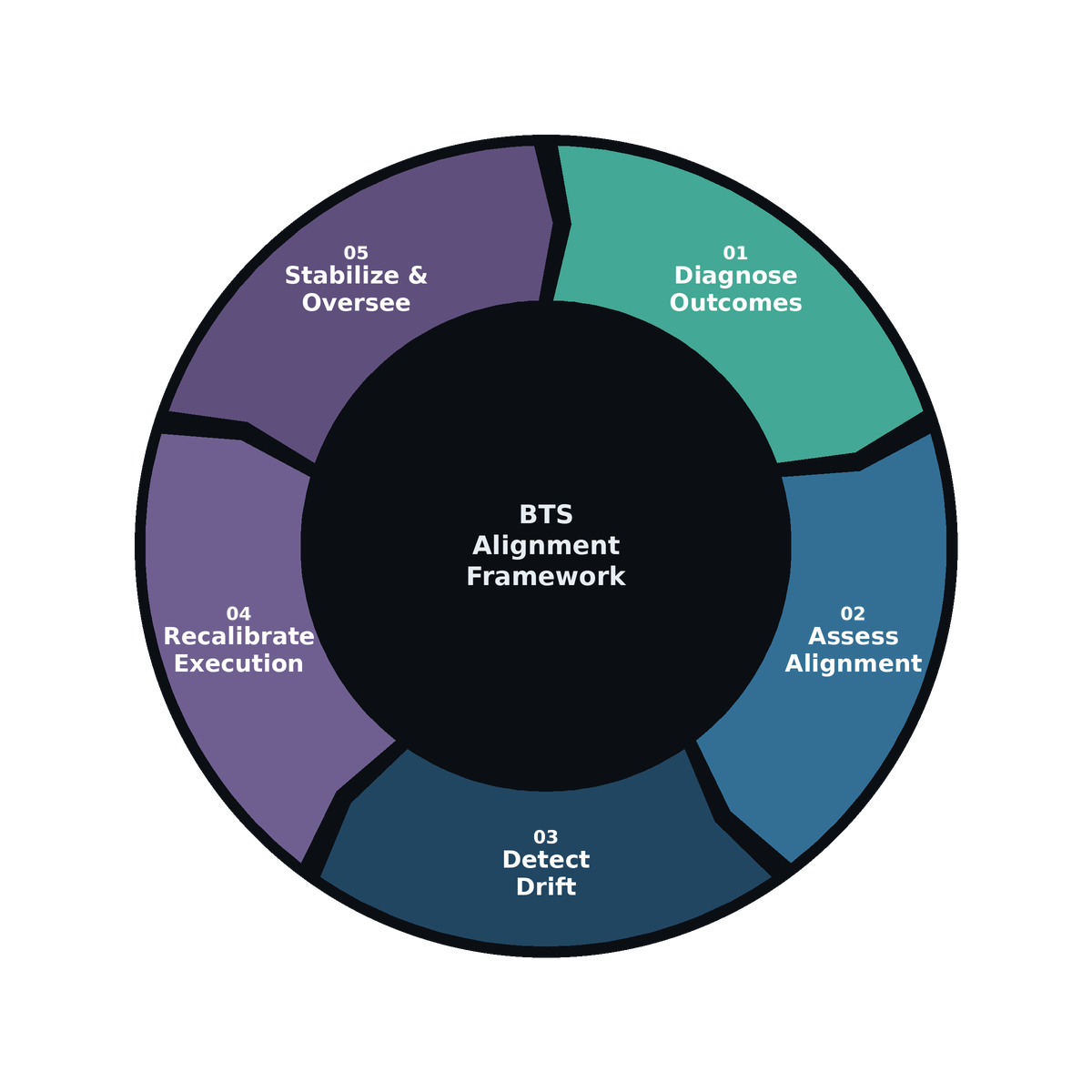
The framework is methodology-agnostic by design. Within each phase, we draw on the practices best suited to the engagement — Agile delivery methods, program and project management standards, service management practices, and regulatory frameworks including RMF — applied in proportion to the needs, maturity, and context of the work. The goal is the right structure for the situation, not adherence to a single approach.
Ready to Bring Clarity to a Complex Program?
Whether you are navigating a program in distress, approaching a major technology decision, preparing for compliance certification, or need experienced support on a competitive pursuit, we bring the experience and structure to help you move forward with confidence.
Contact us to start a conversation about where you are and what is needed.